





Watch Full Video Here: is Day Trading the same as Gambling? ????????????♠️♥️♣️♦️
This question comes up all the time: Is day trading gambling?
I usually hesitate to put those two words in the same sentence because I don’t think of what I do as gambling. I don’t treat trading like a game, and I don’t rely on luck to make money. That said, there are similarities between trading and gambling, and ignoring them doesn’t help anyone.
Some people gamble with their trading accounts. Other people consistently make money. Just like at a casino, a small group walks away profitable, and the majority doesn’t. So what’s the difference? That’s what really matters.
What Does Gambling Actually Mean?
Gambling is usually described as placing bets on games of chance in the hope of winning money or something of value. On the surface, trading looks similar. When you take a trade, the outcome is unknown. Just like a bet on a sporting event, you don’t know whether it will work until it plays out.
That’s where most people stop thinking. And that’s where the confusion starts.
Where Trading and Gambling Start to Separate
The keyword in the definition of gambling is hope. I don’t base my trading on hope. Sure, I’d like my trades to work out, but hope isn’t part of my strategy. If it were, I’d be gambling.
The biggest difference is simple:
- Gambling is hope-based.
- Profitable trading is probability-based.
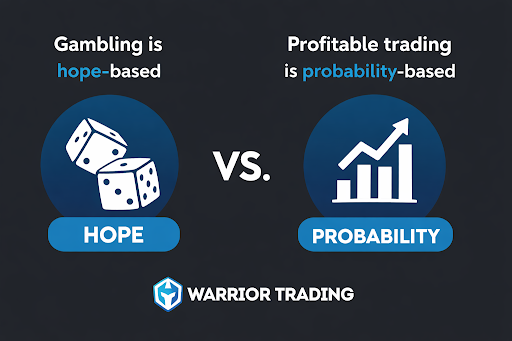
That distinction changes everything.
The Role of Hope in Gambling vs. Trading
When someone trades without a plan, their success is based entirely on luck. You can’t build a career on luck. That’s gambling.
A lot of people start trading because they’ve heard stories about someone making a lot of money. So they jump in, place trades, and hope it works out. Hope is not a strategy.
In contrast, a trader who is doing this the right way relies on a clearly defined trading strategy, historical data, probabilities, and consistent execution
That’s the same mindset used by successful poker players. They’re not sitting at the table hoping the next card saves them. They’re making decisions based on odds, expected value, and discipline.
The Real Similarity Between Trading and Poker
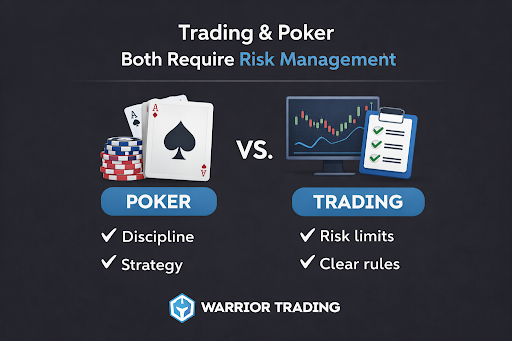
The similarity between day trading and poker isn’t that they’re both gambling. The similarity is that both involve risk and uncertainty. The difference is how that risk is managed.
Professionals in both trading and poker rely on a strategy and discipline, while beginners tend to act emotionally. A trader without rules is gambling, just like a poker player who plays every hand. In both cases, the outcome is predictable.
Why Most People Lose
The majority of day traders lose money. The majority of people who gamble at casinos also lose money. That’s not an accident.
Most traders:
- Don’t have a strategy
- Trade what everyone else is trading
- Chase moves after they’ve already happened
- React emotionally to losses
At a casino, at least you get entertainment. In trading, losing money comes with no perks and no consolation prize. If trading is going to work long-term, consistency matters more than excitement.
When Trading Turns Into Gambling
This is a question my trading coach used to ask me after big losing days: Were you gambling today, or were you trading?
Most of my large losses happened when I broke my own rules. That’s when trading becomes gambling.
Trading turns into gambling when:
- You trade outside your strategy
- You ignore your risk limits
- You size up out of frustration
- You try to make back losses quickly
- You abandon discipline
The moment rules disappear, luck takes over.
How Emotions Cause Traders to Self-Destruct
After a loss, the first emotion most traders feel is frustration. That often turns into anger. That’s human. The problem starts when emotions begin driving decisions.
Instead of stepping back, traders get aggressive. They revenge trade. They double down and try to make back everything they lost on the next trade. This is how a manageable loss turns into a disastrous day.
Losses don’t usually blow up accounts. Emotional reactions do.
Why Risk Management Comes First
Every strategy starts with risk management. Not entries. Not indicators. Risk.
If you don’t have guardrails in place, you’re relying on self-control at the exact moment when self-control is weakest. That’s why professional poker players build systems that prevent emotional decisions. They limit how much money they can access so they can’t spiral when emotions run high.
The same concept applies to trading.
My Max Loss Rule
I set a hard max loss on my account. If I’m down more than a specific amount in a day, I’m done trading. I can’t take another trade even if I want to. That rule exists to protect me from myself. It caps losses and prevents one bad day from turning into something catastrophic.
What a Real Trading Strategy Looks Like
A strategy isn’t vague. It’s specific. I have clear criteria that must be met before I take a trade. If I don’t see that setup, I don’t trade. That’s not hesitation. That’s discipline.
Just like a poker player needs the right cards to stay in a hand, I need the right setup to stay in a trade. When I do see it, I know what I’m working with. When I see that setup, my accuracy on it is around 70%.
That confidence comes from data. I have thousands of trades worth of historical results backing that number. Without data, confidence is just hope.
Discipline Is the Hardest Part
Here’s the part no one wants to hear: it’s not enough to be disciplined 50% of the time, or even 70% of the time. You’ve got to be disciplined 100% of the time.
Because imagine this: you follow your rules all morning, and then on the last trade, you get frustrated, go off the rails, and give it all back. That one lapse can erase everything.
That’s why beginners struggle. They chase. They overtrade. They start taking B setups, C setups, anything that moves.
Professionals do the opposite:
- They wait
- They trade less
- They protect their downside
- They execute only the best opportunities
Sometimes that means trading two or three times a week. That’s fine. If the setups are high quality and your accuracy is strong, that’s the path to profitability.
So, Is Day Trading Gambling?
It depends. If you’re trading without rules, relying on hope, chasing losses, and letting emotions drive decisions, you’re gambling.
If you’re trading a proven strategy, managing risk, and maintaining discipline, you’re trading. Day trading can be gambling, but it doesn’t have to be. The real question isn’t whether day trading is gambling. The real question is whether you are gambling when you trade.
If you want to stop guessing and start trading with rules, risk management, and discipline, learn how to approach the market and build consistency through Warrior Trading.