





The $25k requirement for day trading, also known as the Pattern Day Trader (PDT) rule, is wildly different in 2026. Here’s what replaced it and what you need to know.
For years, new traders have wondered how to day trade without $25K, looking for any possible way to bypass longstanding requirements. The reason was simple: if you had a U.S. margin account and took too many day trades in a short period of time, you could be flagged as a Pattern Day Trader and restricted, unless your account held at least $25,000 in equity.
That rule shaped everything about the way small-account traders approached the market. For some, the solution was a cash account. Some opened multiple brokerage accounts, and some turned to offshore brokers. Now, in 2026, the entire game is different, after FINRA adopted new standards that replaced the old framework.
What the Old PDT Rule Required
Under the old Pattern Day Trader Rule, if you made four or more day trades within five business days in a margin account, and those trades represented more than 6% of your total trading activity during that period, your broker could label you a Pattern Day Trader .
Once you got hit with this classification, you would generally need at least $25,000 in account equity to keep day trading with that account. If you fell below this threshold, you might have seen your account restricted. This was a major roadblock for small-account traders.
You might have had $5,000 or $10,000 in a margin account, managed risk responsibly, and still be limited by the PDT rule . This is why so much advice on day trading without $25K pushed traders toward less-than-ideal options, like splitting small accounts across multiple platforms or holding positions overnight to avoid counting a day trade.
What’s Replacing the $25K PDT Rule?
Starting in June 2026, FINRA replaced the old PDT rule with intraday margin requirements. Now, brokers won’t be counting how many day trades you make; they’ll be focusing on whether your account has enough equity to support the positions you hold during the trading day.
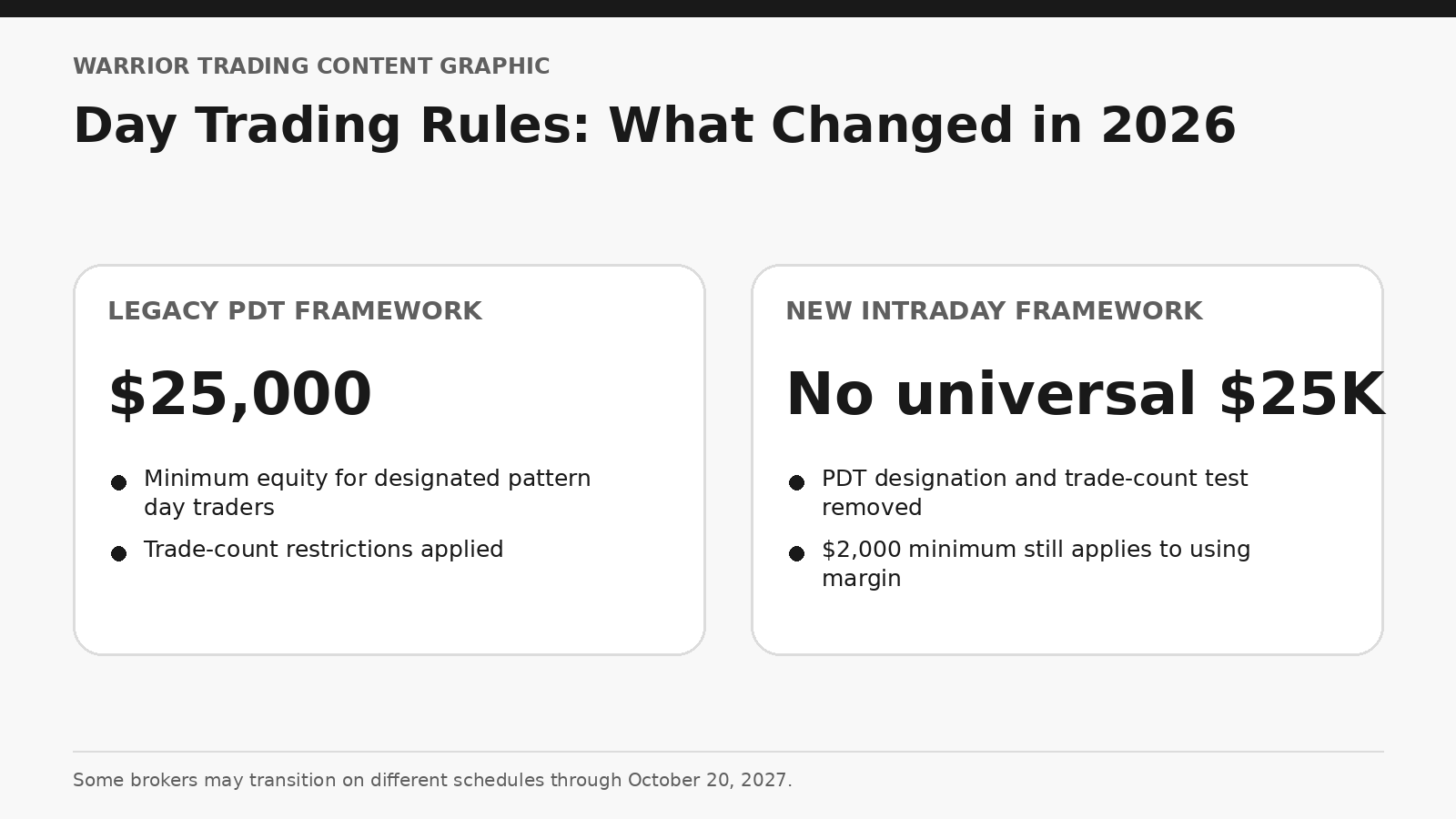
This new system removes the $25,000 day trading minimum and the Pattern Day Trader designation based on counting trades. This is a huge change, and it’s no stretch to anticipate that it will generate a flood of new interest in day trading.
What’s the New Minimum for Day Trading in 2026?
Under the new FINRA framework , you may be able to hold as little as $2,000 in equity to engage in leveraged trading on margin. I say may because firms will be able to hold higher requirements if they choose.
I also want to stress that just because you can trade with as little as $2,000 absolutely doesn’t mean that’s the right number to hold in your account while trading aggressively. Hear me when I say that a lower barrier for entry doesn’t make day trading easier. Small-account traders still need extra discipline and risk management skills to avoid seeing huge losses.
When Did the New Rule Take Effect?
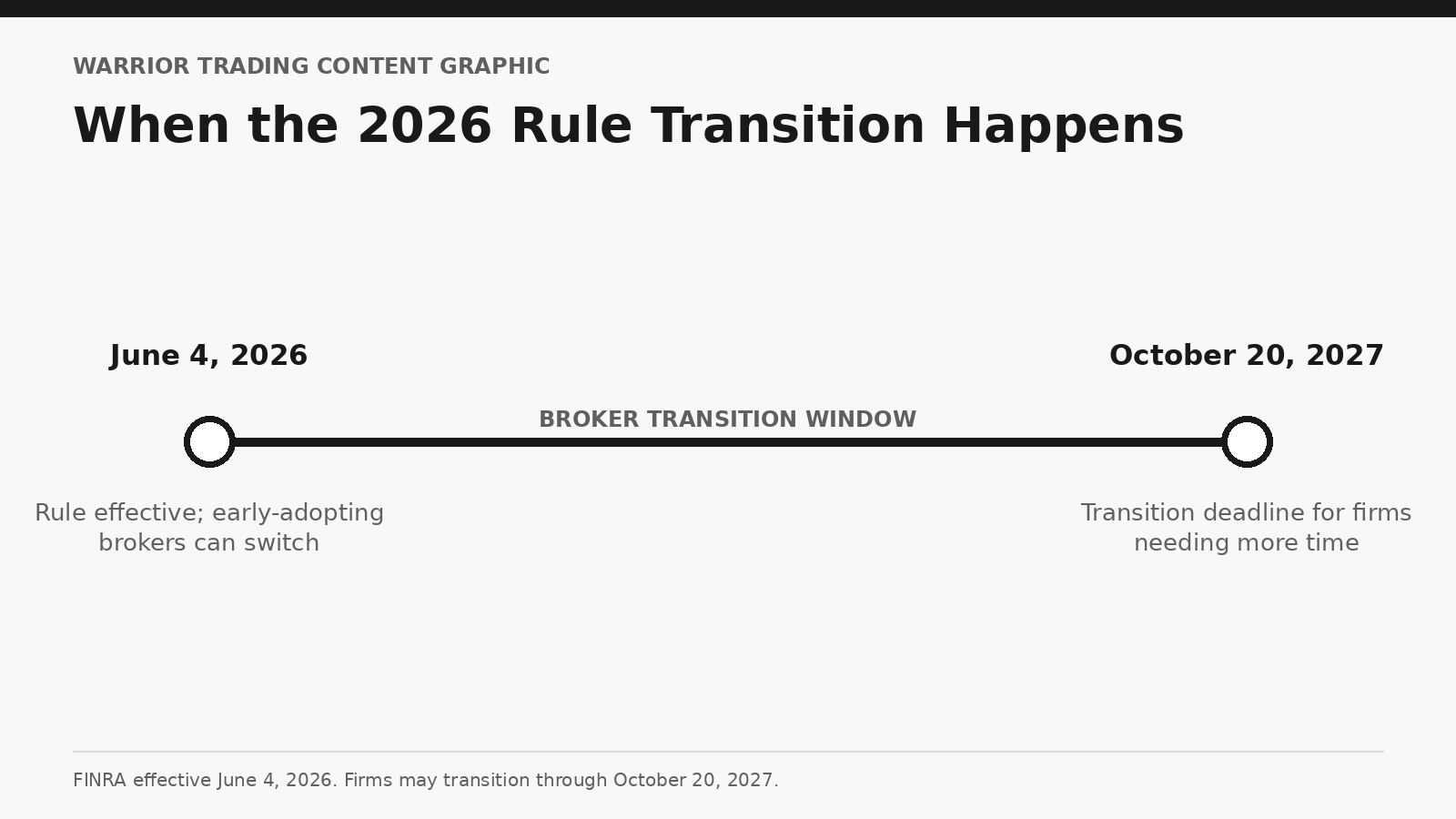
The new requirements for day trading took effect on June 4, 2026, but that doesn’t mean that every brokerage will respond in the exact same way. FINRA has clarified that every brokerage firm has its own 18-month phase-in period, which will end on October 20, 2027. This gives the firms extra time to implement the new standards.
Keep this in mind if you are a new trader. You’ll need to check with your own broker before assuming that the old PDT restrictions are gone from your account. I’m anticipating that this transition period will create a short-term spike in confusion for new traders. You may see different policies, depending on your broker, account timeline, and other factors.
How Should You Day Trade Under the New Rules?
Once your broker implements the new FINRA framework, I’d recommend a standard U.S. margin account as the simplest option for day trading without $25K.
This type of account gives you flexibility, and with many brokers, you can expect to be able to enter the game with as little as $2,000. However, I highly recommend adjusting your risk management strategy based on how much is in your account.
If you’re trading a $2,000 account, you should trade like someone protecting a $2,000 account. Using a paper trading simulator to practice can go a long way here.
Consider a Cash Account
I’ve often been surprised by how many day traders don’t realize that the PDT rule never applied to cash accounts. These accounts are still relevant now, even with the PDT rule changing.
A cash account is different from a margin account because you’re trading with settled cash instead of borrowed funds or margin buying power. Just like before, you can generally make as many day trades as you want, as long as you have the settled cash available.
This is a solid option for beginners because it slows you down and forces you to be more selective. This can help prevent overtrading, especially if you’re still building up your discipline and self-restraint.
Trading Without $25K Is Easier Than Ever, But Be Wise
The $25K PDT rule is gone, which means you may be able to trade with as little as $2,000 in your account. This is a major change, and in my opinion, it’s a good one for retail traders. The basics aren’t changing, though. Before you start trading, practice in a simulator and take in as much advice from experienced day traders as possible.
Sources:
FINRA Adopts New Intraday Margin Standards to Replace the Day Trading Margin Requirements | FINRA
Understanding the New Intraday Margin Requirements | FINRA
Understanding Pattern Day Trader (PDT) Rules and Margin Requirements | Investopedia