





Updated August 3, 2026 – Written by Ross Cameron
Key Takeaways
-
The old requirement of $25,000 in your margin account to avoid being labeled a Pattern Day Trader is going away. In its place, FINRA is using a new intraday margin framework.
-
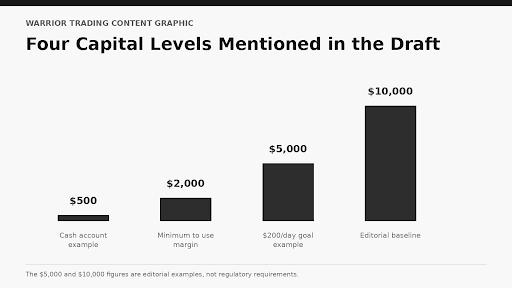
Under FINRA’s new framework, the standard margin minimum can be as low as $2,000, but this minimum depends on broker rules.
-
Just because you can potentially day trade with only $2,000 in your margin account doesn’t mean that’s the best place to start.
For years, the simple answer was $25,000 if you wanted to actively day trade stocks with a U.S. margin account. That number came from the Pattern Day Trader (PDT) rule, which limited traders with smaller margin accounts to just three trades over a rolling five-business-day period.
However, in 2026, the PDT rule is being replaced, meaning the minimum for a day trader’s margin account will change. Under FINRA’s new framework, you may be able to day trade with as little as $2,000 in your account. Just because you can doesn’t mean you should, though.
Here’s what you need to know about the new entry requirements for day trading in 2026 and how I recommend handling them.
How Much Do You Need To Day Trade in 2026?
As I mentioned, FINRA has adopted a new framework that replaces the Pattern Day Trader Rule. This framework generally bases your buying power on the amount of risk you are taking. That means that your broker may let you hold much less than the old minimum of $25,000 in your margin account and make more than the old limit of three trades in five business days.
There’s a caveat, though. Brokers have until late 2027 to adopt FINRA’s new intraday margin rule, so your broker may have specific limits for you to follow. Even so, you may be allowed to day trade with as little as $2,000.
Should You Day Trade With $2,000?
If you’re just getting started with exploring day trading, you may be excited to hear that the barrier to entry is much lower. But this comes with some big pros and cons.
For new day traders, I would strongly advise against looking at a $2,000 account and thinking, “Now I can trade big.” To make this amount of money work, you’ll need to manage risk and limit your perceived buying power.
If you decide to day trade with only $2,000, you may need to risk just $20 or $30 per trade as you learn. That might not sound very exciting, but I recommend it. Higher risks with an account of this size can wipe you out fast.
What’s a Better Starting Amount for New Traders?
Under FINRA’s new requirements , your broker might let you open a margin account with just a few thousand dollars. However, opening the account with the minimum balance means a loss could quickly put you below the requirements. Give consideration to funding the account with room for you to “breathe” with expected losses, but don’t risk more than you can afford to lose.
If you’re not ready for a margin account or to meet the $2,000 minimum, you can consider a cash account. Just keep in mind that the smaller your account, the lower the risks you’ll be able to take.
What About a Cash Account?
Under the PDT rule , using a cash account was one of the best ways to work around the $25,000 requirements, which only kicked in when you used a margin account to trade.
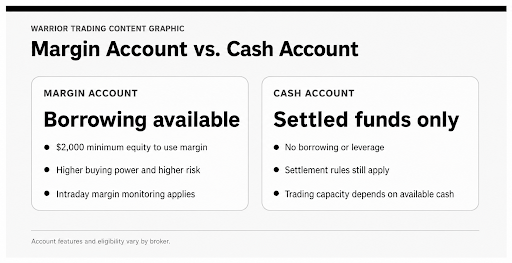
With a cash account , you only trade with settled funds instead of money borrowed from a broker. This, of course, lowers your buying power, but it also lowers the barrier of entry for trading.
You can open a cash account with $500 as your first step after practicing on a day-trading simulator , which can help you get used to risk management and controlling your emotions . It’s a great choice if you’re just getting started and want to wait before setting larger daily goals and taking bigger risks.
What’s a Realistic Daily Earning Goal for Day Trading?
As you can imagine, it’s tough to make a living day trading unless you fund your margin account with enough money to take meaningful risks.
If your goal is to make $200 a day as a new day trader, I recommend funding your account with at least $5,000, and more if you can afford it. This amount gives you more room to manage risk. However, if you want to make more serious money trading, you’ll most likely need a larger account, a proven strategy, and enough experience to handle drawdowns.
Only Take Risks You Can Handle
If your long-term goal is to make a living day trading, start only taking the risks that won’t sabotage your finances . If you can’t afford to lose it, don’t use it to fund your account. I can’t stress enough that you should never use money earmarked for rent, mortgage payments, or other key expenses to fund your account.
You don’t have to start making hundreds per day right away. Make sure you’re financially and emotionally ready before you increase the risk.
Takeaway: Start Small, But Not Too Small
2026 brings big changes to the way day trading works . With the PDT rule gone, you can now day trade with only a few thousand dollars in your account. Still, while you may be able to start day trading with just $2,000, you’ll have more flexibility to make riskier trades if you start with more.
If you aren’t financially prepared to open a margin account, I recommend opening a small cash account or just honing your skills with a trading simulator for a time. There’s no rush to start earning big; it’s better to get confident and comfortable on a small scale.
Sources:
Regulatory Notice 26-10 | FINRA.org
FINRA Moves to Overhaul Day Trading Margin Provisions | FINRA
Thinking of Day Trading? Know the Risks. | Investor.gov