





The pattern day trader rule , often referred to as the PDT rule, is one of the most misunderstood stock market terms amongst many beginner traders. This rule was established in 2001 by the Financial Industry Regulatory Authority ( FINRA ) and the U.S. Securities and Exchange Commission ( SEC ).
Today, we are going to focus on the rule and what has changed, including whether you even need workarounds anymore now that the SEC has approved the new $2,000 minimum.
The original rule was put into place in part to protect novice traders from losing their money. Since the vast majority of traders lose money, you need to approach this with serious caution and with the expectation that you could lose money.
For that reason, you should day trade in a simulator before you put real money on the line. Now, with that said, let’s get into the PDT rule!
Do You Still Need To Get Around the PDT Rule?
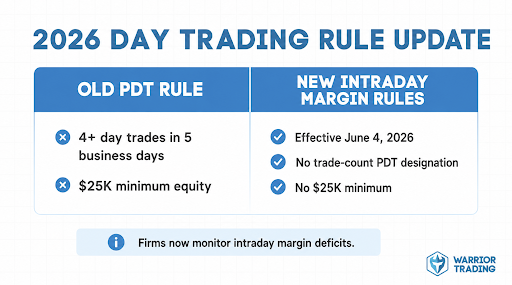
Here’s the most important thing to know right now: the PDT rule has effectively been eliminated . In April 2026, the SEC officially approved FINRA’s amendments eliminating the $25,000 minimum account balance requirement for day trading in a margin account.
Traders can now trade freely in a margin account, which requires a minimum balance of $2,000 — no more three-trade-per-five-day restrictions — once their broker implements the new rules. Brokers can begin rolling this out 45 days from FINRA’s regulatory notice, which is June 4th, 2026, with up to 18 months to fully comply.
That said, understanding your options still matters. The cash account strategy remains just as relevant as ever. And for traders who want maximum flexibility or are working with very small accounts , the other methods we’ll cover below are still worth knowing. The goal here isn’t to help you dodge the rules — it’s to help you understand how to trade smart within them.
What Is the PDT Rule?
Under the original rule enacted in 2001, the PDT rule required traders seeking to day trade more than three times in a rolling five-day period to keep a minimum balance of $25,000 in their margin accounts.
Under the new rule approved by the SEC in April 2026, that minimum balance requirement has been reduced to $2,000 — a significant change that opens the door for many more traders to participate without workarounds.
Under the old rule, if an account fell below $25,000, the trader could no longer execute day trades until the account was topped back up. Under the new rule, that threshold is $2,000.
FINRA had previously defined a pattern day trader as any customer:
-
Who used a margin account
-
Who executed four or more “day trades” within five business days in a margin account
-
Whose day trades formed more than 6% of his/her total trading activity for the same 5-day period
The PDT rule was designed as a protective measure aimed at preventing traders from trading excessively in the stock market by limiting their trading activity.
The original rule assumed that traders with over $25,000 in account equity had accepted the risks of day trading. The updated rule acknowledges that traders with a much smaller account balance can still approach the market responsibly.
Under the old rule, falling below $25,000 triggered a margin call with a 5-business-day window to restore the balance. Under the new rule, that threshold is $2,000.
How To Make the Most of the New PDT Rules
With the $25,000 threshold now officially eliminated, the landscape looks very different from what it did even a year ago.
Here’s a full breakdown of your options, from the simplest to the more advanced:
#1 Using a Cash Account to Day Trade
Using a cash account was an easy way to avoid the PDT rule. It can still be valuable for those who don’t want to fund a $2,000 margin account and begin with a smaller investment. The only setback with a cash account is you can only use settled funds.
This means when you buy or sell a stock in a cash account, the money takes 1 day (T+1) to settle before you can use it again.
So for example, if you sold a stock on Monday, those funds wouldn’t settle until Tuesday. Monday is the trade date, then Tuesday morning the funds are available.
If you have a $1,000 trading account, buying 500 shares of a $2.00 stock would use all your buying power , and after selling that position you won’t be able to trade again until the following day.
Here’s a practical example of how to think about sizing in a cash account: if you’re working with a $2,000 cash account, you might limit yourself to $500 in gross exposure per trade. That means if you’re buying a $5.00 stock, you’re taking 100 shares. You won’t get rich overnight, but you’ll stay in the game long enough to build consistency, and that’s the real goal early on.
However, for traders focused on building consistency, trading with a small share size in a commission-free cash account can be a valuable learning experience.
#2 Swing Trading as an Alternative
If the PDT rule was limiting your activity, swing trading was worth considering as a complement to day trading. Swing trades are held overnight or for several days, which means they don’t count toward your day trade tally. You could have been very active in the market — entering and exiting positions frequently — without ever triggering the PDT rule.
The tradeoff was that swing trading carried overnight risk. Stocks could gap up or down significantly after hours, and you wouldn’t be able to react in real time. But for traders still building their accounts toward the margin account minimum, swing trading could keep you engaged in the market in the meantime.
#3 Futures Trading (No PDT Rule Applies)
Here’s something a lot of new traders don’t realize: the PDT rule doesn’t apply to futures trading . At all. Futures contracts — including products like /ES (S&P 500 futures), /NQ (Nasdaq futures), and /CL (crude oil) — are governed by different regulations, and there is no pattern day trader restriction in the futures market.
This means you can day trade futures as many times as you want, regardless of your account size. Micro futures contracts, like the Micro E-mini S&P 500 (/MES), require very little capital to trade. For a trader with a $2,000 account, that’s genuinely accessible.
The learning curve is different from stocks, and futures carry their own risks, but for traders who want unlimited day trades without worrying about the PDT rule, futures are one of the cleanest solutions available.
#4 Prop Trading Firms
Prop trading firms are another option that’s grown significantly in popularity. With a prop firm, you trade the firm’s capital rather than your own. Because you’re not trading a personal margin account, the PDT rule doesn’t restrict you the same way.
Most prop firms require you to pass an evaluation or “combine” — essentially a simulated trading test — before funding you. If you pass, you get access to a funded account, often ranging from $25,000 to $150,000 or more. You keep a percentage of the profits, typically between 50% and 90%.
The practical cost is the evaluation fee, which typically runs between $100 and $600, depending on the account size. For a trader who has proven consistency in a simulator but doesn’t yet have $2,000 to fund a personal margin account, this can be a compelling path. Just do your due diligence — not all prop firms are created equal.
#5 Using an Offshore Broker
Offshore brokers were never required to enforce the $25,000 PDT minimum, which made them a popular workaround for US traders with smaller accounts. With that minimum now eliminated domestically, the case for using an offshore broker has all but disappeared for most traders.
For US residents looking to trade with an international broker, there are only a small handful that will accept us. These brokers tend to be located in the Caribbean, including in the Cayman Islands and the Bahamas.
An offshore broker will have lower minimum account deposit requirements (typically $500), will offer 6x leverage, and will not enforce the PDT rule. However, there are some drawbacks. With a non-US broker-dealer, you are no longer covered by US Federal Deposit Insurance, which would protect funds you deposit into a US brokerage account. Additionally, international brokers will charge high fees and commissions that will eat away at a small account.
With the domestic threshold now set at $2,000, the added costs, reduced protections, and regulatory complexity of offshore brokers are impossible to justify. You can now achieve the same flexibility right here in the US with a regulated, FDIC-insured broker. I’d consider offshore brokers essentially obsolete for US day traders going forward.
For most beginner traders, using a cash account until they are profitable is the best way to get started.
Comparing Your Options: A Quick Reference
Note: With the SEC’s April 2026 approval, the Margin Account option is now the simplest path for most traders with $2,000 or more.
| Method | PDT Rule Applies? | Min. Capital Needed | Key Tradeoff |
| Cash Account | No | Any amount | T+1 settlement limits same-day reuse of funds |
| Multiple Brokerage Accounts | No | Any amount (split across accounts) | Requires discipline to manage risk across accounts |
| Swing Trading | No | Any amount | Overnight risk; slower pace |
| Futures Trading | No | ~$500–$1,000 for micro contracts | Different learning curve; leverage risk |
| Prop Trading Firm | No (trading firm capital) | $100–$600 for evaluation | Must pass evaluation; profit split |
| Offshore Broker | No | ~$500 | Higher fees, no FDIC protection, less compelling post-rule change |
| Margin Account (new threshold) | No | ~$2,000 | Unlimited day trades once broker implements the new rules. Leverage is broker-determined under new Intraday Margin Standards. |
Bottom Line
The SEC approved the PDT rule change in April 2026, and the $25,000 barrier that stopped so many small account traders is gone. Once your broker implements the new rules, all you need is $2,000 in a margin account to day trade freely. That’s genuinely exciting news for anyone building from the ground up.
My advice? Start in a trading simulator . Get consistent. Then fund a small account and treat every trade like real money, because it is.
Whether you go the cash account route, explore futures, or eventually work toward a funded prop account, the fundamentals are the same: manage your risk, keep your share size small, and focus on making good decisions rather than making big money fast.
The PDT rule was never the real obstacle, and now it’s no longer an excuse either. Discipline and consistency are what separate traders who make it from those who don’t.