





When I first started trading, I quickly realized that growing a small account was one of the biggest challenges. I had the skills and strategy, but my potential profits were limited without sufficient capital.
That’s when I discovered the power of leverage. Leverage allowed me to take larger positions than my account balance would typically permit, providing an opportunity to amplify my gains.
Your goal is a hundred dollars a day. You’re trying to grow the account 10% each day. That’s the mindset I had starting out. Small daily wins — multiplied through leverage — add up fast when executed with discipline.
In this article, I want to share what leverage trading is, how it works, and how I’ve used it to grow my trading account. I’ll also discuss the risks involved and how to manage them effectively.
What Is Leverage Trading?
Leverage in trading is using borrowed money from your broker to take a larger position than your cash balance would allow.
That sounds simple, but it’s one of the most important concepts for new traders to understand. Leverage can help you make meaningful trades with a small account, but it can also make losses hit much faster.
When you use it carefully (like I’ll outline below), leverage can be a tool. If you use it recklessly, it might be the way you blow up your account, as leverage is not for beginner or inexperienced traders.
Why Leverage Trading Is More Relevant Than Ever
This topic is especially important right now because the old Pattern Day Trader (PDT) rule is no longer in effect, making intraday leverage trading more accessible to new traders with smaller accounts.
Here’s what I’m talking about: after June 4, 2026, the Pattern Day Trader rule was replaced. For years, traders with U.S. margin accounts generally needed at least $25,000 to day trade actively. In the past, if your account balance fell below the $25,000 threshold and you made four or more trades within five business days, your broker could impose restrictions on your account.
FINRA introduced new intraday margin rules , allowing traders to enter the market with as little as $2,000. However, these new rules won’t universally take effect all at once; firms have an 18-month phase-in period that ends on October 20, 2027.
With these new requirements in place, more traders than ever may be able to take advantage of intraday leverage trading.
How Leverage Trading Works
In practice, leverage trading is when your broker lets you control a larger position than the amount of cash you have in your account.
For example, if you have $2,000 in a margin account and your broker gives you access to 4:1 intraday leverage, that means you can potentially take a position worth up to $8,000 during the trading day.
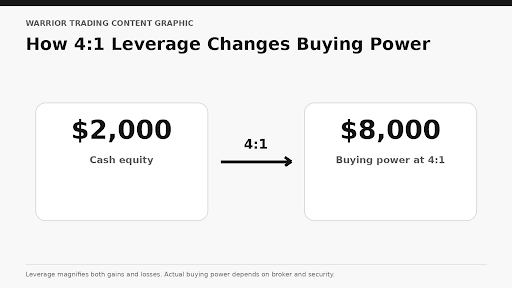
There are huge, obvious benefits here for day traders . With a small price move, you can create a larger dollar gain because you’re trading more shares than your cash balance alone would allow. However, the risks are big as well. A small price move against you can create a disproportionately large loss.
The Risks of Leverage
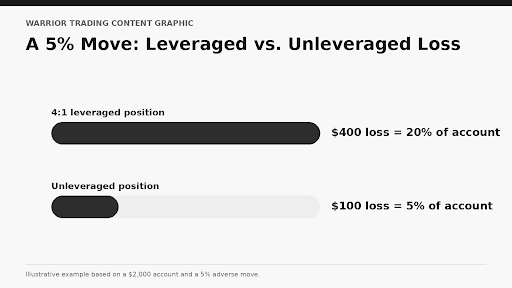
Here’s how that loss works. If you have $2,000 and take an $8,000 position, a 5% drop in that position is a $400 loss. That’s a 20% hit on your account. Just one trade like that can do serious damage, especially if you’re new and still learning how to manage your emotions. This is where using a day trading simulator can be incredibly helpful.
I don’t ever think of leverage as “free buying power.” It’s better to describe it as “borrowed risk.” Your broker may give you access to it, but you have to handle the consequences if you end up experiencing a loss.
Smart Ways To Manage Leverage Risk
Here’s how I stay safe with leverage:
-
Position sizing: I only risk a small percentage of my account on any trade. Leverage doesn’t change that.
-
Stop-loss orders: Every trade I take has a defined risk level. If it hits, I’m out — no questions asked.
-
Active monitoring: I don’t walk away from a leveraged trade. I’m at the screens and ready to act.
The takeaway? Use leverage only when you have the experience, the strategy, and the discipline to back it up.
Margin Accounts vs. Cash Accounts for Leverage
A margin account is what allows you to use leverage. A cash account only lets you trade with settled cash that is already in your account. With a cash account, you can’t borrow from your broker to increase position size. This can limit your buying power, but it also limits the risks we just discussed.
For beginners, I often recommend cash accounts. They slow you down, since you only have a limited amount of settled cash available. This forces you to be more selective, but you won’t be able to engage in the high-risk, high-reward leverage trading that you’d get with a margin account.
I would argue that cash accounts are more beginner-friendly because margin accounts require more discipline and offer a sometimes dangerous amount of flexibility. When you use leverage, your losses are amplified. Even with the changes to the PDT rule , your broker can restrict your account, issue a margin call, or even liquidate positions if your account equity gets too low.
Do the New Rules Mean Everyone Gets 4:1 Leverage?
The changes to the PDT rule might have you wondering if every trader with a margin account will get access to the type of 4:1 leverage that can get you potentially huge returns. This won’t automatically be the case.
This is where all day traders, especially new traders, need to be careful. The old PDT system included a specific day trading buying power calculation. This new framework replaces that system with intraday margin requirements. This means that leverage access has more to do with your broker’s risk controls, your account equity, and the margin requirements of the positions you’re trading.
FINRA explains that there is a standard 25% minimum equity requirement during the trading day, but that firms can impose higher requirements. In other words, you will need 25% equity for the possibility of 4:1 intraday buying power.
My Leverage Strategy Today
Leverage might’ve helped me grow a small account in the early days, but the way I use it now looks completely different. It’s all about strategy, not speed.
Strategic, Not Automatic
Over the years, my approach to leverage has evolved. I no longer use leverage indiscriminately — I use it as a strategic tool, only when market conditions align with my trading plan.
I assess each trade individually. I look at the volatility, volume, and strength of the setup before deciding whether to step in with size. If the market feels choppy or the setups aren’t clean, I’ll scale back and trade with just my own capital — no hesitation.
There are days when I don’t use leverage at all. And there are days when the momentum is strong, and I’ll lean in and use more of what’s available to me. The key is flexibility and discipline.
You’ve Got To Earn That Risk
One thing I always remind traders: just because you have access to leverage, doesn’t mean you should use it every time.
Just because your broker lets you trade with leverage doesn’t mean you should — you’ve got to earn that risk. That line has stuck with me for years. Leverage isn’t a reward — it’s a responsibility. You use it when your setup is strong, your mindset is sharp, and your risk management is already in place.
Refined With Experience
A solid setup and high probability trade — that’s when I’ll consider stepping up with size. But even then, my stop losses are tight, and my risk is calculated.
Ultimately, my leverage strategy today is more refined than when I started. I’ve made mistakes. I’ve learned from the account blowups. And now I know — restraint is just as powerful as aggression when you’re trading with borrowed money.
Conclusion
Leverage trading can be a game-changer, especially when you’re starting out with a small account. It gives you the power to take trades that might otherwise be out of reach. But it’s a double-edged sword — what helps you grow can also cut deep if you’re not careful.
With the new changes to the FINRA framework for day trading, leverage is potentially more accessible than ever. Under the new rules, a trader with $2,000, $5,000, or $10,000 may be able to try leverage trading, whereas it used to take a minimum of $25,000.
Keep in mind that with leverage, the smaller the account size, the more important risk management becomes. If you’re new, don’t start by asking, “How much leverage can I get?” Start with, “How much can I afford to risk?”
That question can keep you in the game much longer. Trading is risky, and most day traders lose money. Leverage adds a new element of risk and reward into the mix, and it makes discipline even more important.
Sources:
Regulatory Notice 26-10 | FINRA.org
Understanding the New Intraday Margin Requirements | FINRA.org
What Is Financial Leverage, and Why Is It Important? | Investopedia