





- What Is a Stock Screener?
- How Stock Screeners Work Behind the Scenes
- Key Filters I Look For
- Why Simplicity Beats Over-Filtering
- How I Use Stock Screeners in My Trading Routine
- My Morning Setup
- How I Validate Stocks After Screening
- Common Mistakes Traders Make With Screeners
- Final Thoughts — Make Your Screener Work for You
Watch Full Video Here: Stock Scanners for Beginner Day Trading Strategies
Every morning before the bell, I’m running my scanners. Without them, I’d be blind. A stock screener is one of the most important tools in my trading setup. It saves me hours of guesswork and helps me find the small-cap momentum stocks that actually have potential.
When I first started trading, I’d waste time flipping through random tickers, trying to catch something that looked “hot.” That’s not a strategy — that’s gambling. A screener takes the chaos out of that process. It filters thousands of tickers down to a handful that match my criteria, including the price range, volume, and float size I’m looking for.
Once you’ve got a screener dialed in, it’s like turning on a radar before takeoff. It shows you where the action is, long before everyone else catches on.
What Is a Stock Screener?
A stock screener is basically a filtering tool. It lets me sort through the entire market using specific criteria, like price, float, and trading volume. Think of it as a sieve: I pour all the market data through it, and only the stocks that meet my conditions make it through.
I often see people confuse screeners with scanners. Here’s how I separate them:
- A stock screener is something I’ll use premarket, giving me a list of stocks that fit my filters based on yesterday’s or early-morning data.
- A stock scanner, on the other hand, works in real time, alerting me when new stocks start moving right now.
I’ve actually developed each of these scanners to look for very specific types of setups. When I’m looking for small-cap momentum setups, I rely on my screeners to show me which stocks are gapping up on volume before the open. That’s where my day starts.
How Stock Screeners Work Behind the Scenes
Screeners pull market data — either real-time or slightly delayed — and filter it through whatever criteria I set. That’s how I narrow down thousands of tickers into a list of maybe five or 10 that are actually worth watching.
They’re not predicting price moves but surfacing potential. My job is to read the chart, confirm the setup, and manage the trade.
Key Filters I Look For
I keep things simple. Here are the filters I rely on every single morning:
- Price range: Usually between $2 and $10. That’s where I find most small-cap momentum.
- Volume: At least 500,000 shares traded premarket.
- Float: Under 10 million shares. I color flow and prioritize lower float stocks because we know lower float stocks are the ones that can make really big moves.
- Relative volume: Over 2x the average.
- Market cap: Typically under $100 million.
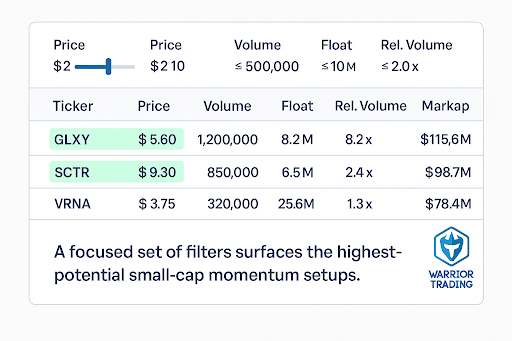
I like to keep my float under 10 million shares; that’s where you find the big movers. Small floats with high volume can explode fast, and that’s the type of momentum I trade best.
Why Simplicity Beats Over-Filtering
A mistake I see all the time: traders loading their screeners with too many filters. If you get too specific, you choke off good opportunities before they even appear.
I’d rather see ten decent setups and eliminate a few manually than miss the one perfect trade because my screener was over-tuned. Keep your filters simple. The goal isn’t to create a perfect list but to spot activity early and react with a plan.
How I Use Stock Screeners in My Trading Routine
Every morning before the market opens, I go through the same process. I’m looking for stocks that are already moving with strong premarket volume or breaking news. My screener gives me that first look at where the crowd is focusing.
My Morning Setup
By 7:00 a.m. ET, I’m already running scans and watching for momentum. I’ll sort results by percentage change and volume. Once I’ve got my top tickers, I’ll check the charts for clean setups: breakouts, flags, or any pattern I’ve traded successfully before.
If it’s gapping up with volume and has news, that’s where my eyes are. That’s been my rule for years. It’s not about guessing; it’s about recognizing strength early.
How I Validate Stocks After Screening
Once I’ve got my filtered list, I don’t just jump in. I verify. I check the daily chart, then the one-minute or five-minute chart for clean setups with real volume. If the chart looks sloppy or thin, I move on.
I focus on patterns I trust: breakouts, flags, and clear levels. When a setup lines up with volume and momentum, that’s my cue. The screener gives me the map, but I still have to drive the trade.
Common Mistakes Traders Make with Screeners
I’ve seen a lot of traders misuse screeners, and I’ve made these mistakes myself. Here are a few of the biggest traps:
- Overloading with filters. Too many filters and you’ll miss real setups.
- Ignoring context. A screener doesn’t care about the market environment, so you have to.
- Reacting emotionally. Just because something pops up doesn’t mean you chase it.
- Skipping risk management. Screeners don’t calculate your stop losses for you.
The most dangerous thing a trader can do is assume a screener is a signal generator. It’s not. The screener finds opportunities, not guaranteed profits. That part’s still up to you.
Final Thoughts — Make Your Screener Work for You
A stock screener is one of the most powerful tools in my trading routine. It helps me focus on stocks with volume, volatility, and news catalysts, but it doesn’t trade for me. You can have the best filters in the world, but without discipline and solid execution, they mean nothing.
If you want to see how I use my scanners and screeners live, join me at Warrior Trading. Learn the tools, build your routine, and trade smart — that’s how you turn scanning into skill.