





- The SEC’s Approval of FINRA’s PTD Rule Changes April 2026
- When the PDT Rule Will Change
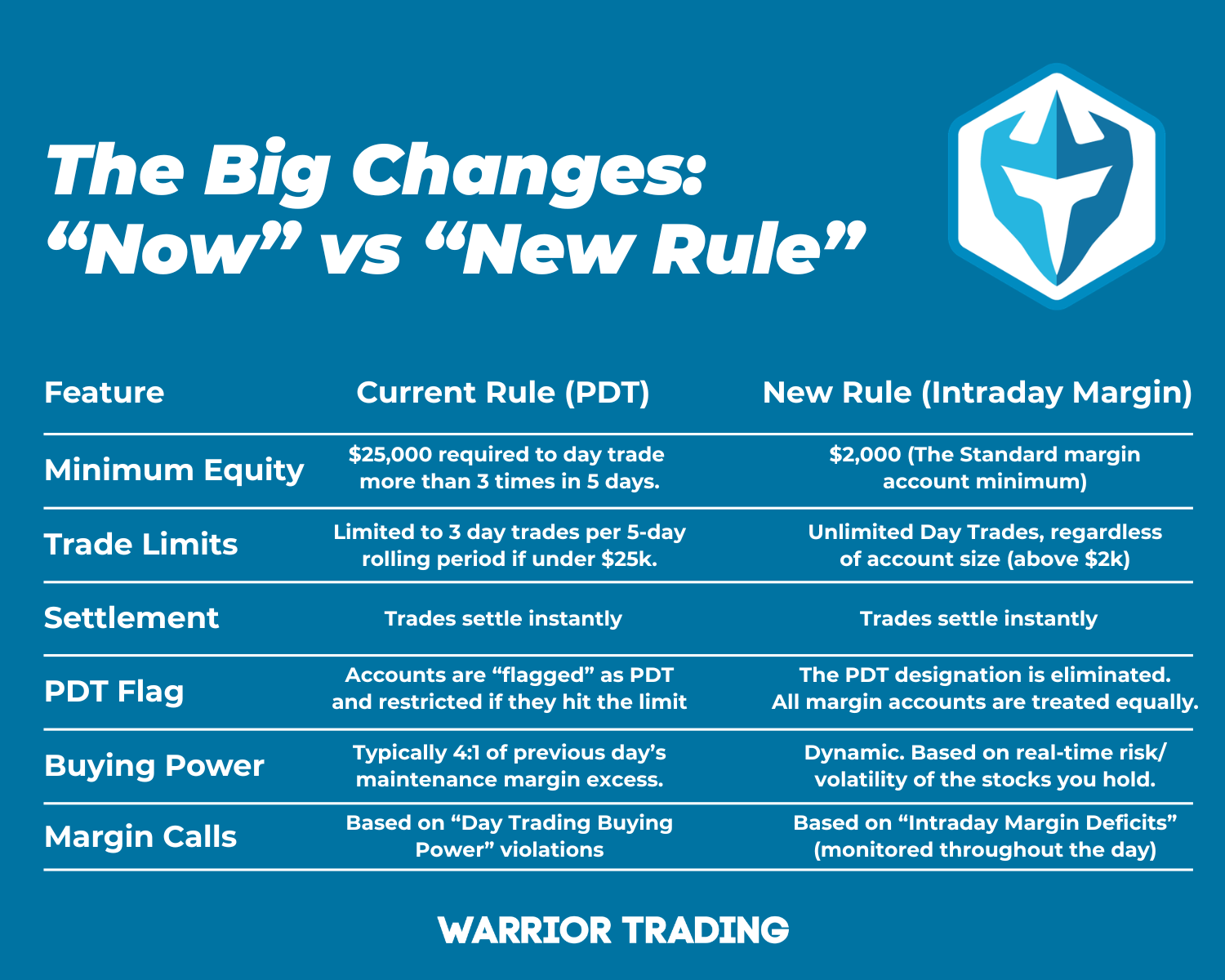
- Comparison: New vs Old PDT Rule for Margin Accounts
- What the Pattern Day Trader Rule Has Been
- What Exactly Is Changing?
- How the Old PDT Rule Backfired for Beginners
- Offshore Brokers and Unintended Consequences
- Margin vs. Leverage: What Most Traders Actually Want
- How the Trading World Has Changed Since 2001
- Technology Is Completely Different Now
- Retail Traders Have Far More Choices
- Commission-Free Trading Changed Everything
- The Rise of Retail Traders
- Why a Lower Minimum Can Actually Reduce the Damage
- What This PDT Rule Change Means for Me – and for You
Watch Full Video Here: HUGE Announcement on the PDT Rule…
I’ve been dealing with the pattern day trader rule since the first day I opened an account. For almost 25 years, it’s forced new traders into workarounds, big balances, and leverage they weren’t ready for. Now, the SEC has approved the changes FINRA proposed to the pattern day trader rule, and it’s the biggest shift I’ve seen in my career.
If you trade U.S. stocks, or you’ve ever wanted to start with a small account, this update affects you directly. Let’s break down what the old rule was, what’s changing, and what it means for anyone learning to trade today.
SEC Approves PDT Rule Changes in April 2026
The SEC announced on April 14th, 2026 that it has approved the changes FINRA proposed to the Pattern Day Trader Rule. You can read their full order here.
When Will the PDT Rule Change Take Effect?
On June 4th, 2026 is the date changes take effect for the Pattern Day Trader Rule.
FINRA published their regulatory notice on Monday April 20th, 2026 and brokers can begin implementing the change 45 later which will be June 4th, 2026. Note that brokers will have 18 months to implement the changes. While many are likely eager to welcome more customers and will implement the new rules for margin accounts 45 days after FINRA publishes the notice of the rule change, they do not have to implement the changes immediately but must do so within 18 months.
New vs. Old PDT Rule for Margin Accounts
The main change traders will enjoy is that the minimum now required for a margin account is only $2,000. With a margin account, trades will settle instantly and you won’t be restricted on the number of trades you take. Margin and buying power will be determined by risk.
What the Pattern Day Trader Rule Has Been
The pattern day trader (PDT) rule came in after the dot-com bubble. The idea was simple on paper: protect people from blowing themselves up when using a margin account.
Under the old framework, if you took more than three day trades in a rolling five-day period in a margin account and were a U.S. resident, you were labeled a pattern day trader and required to keep at least $25,000 in that account to keep trading.
The proposed change drops that minimum from $25,000 down to around $2,000. On paper, that sounds like a small tweak. In practice, it’s a big structural shift.
What Exactly Is Changing?
Here’s the quick breakdown of the proposed update:
- Old minimum: $25,000
- New Minimum: around $2,000
- Applies to: margin accounts for U.S. traders
- What it means: more flexibility, fewer restrictions, and less pressure to use offshore brokers or take on heavy leverage just to trade actively
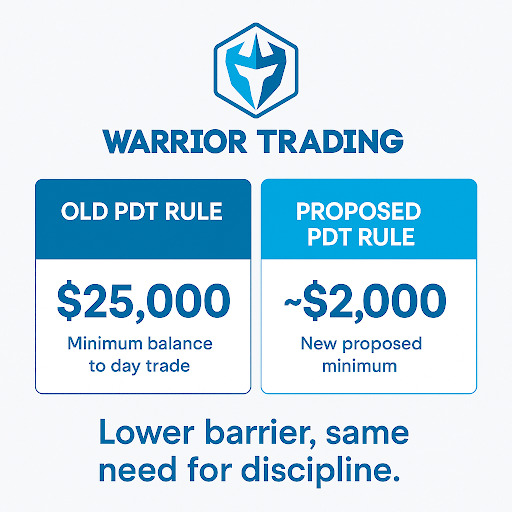
It looks like a simple adjustment, but dropping the requirement this far down reshapes how beginners can approach the market.
How the Old PDT Rule Backfired for Beginners
I opened my first trading account in 2001, right as the PDT rule went into effect. Like most new traders, I was active, took more than three day trades in five days, got flagged, and my broker basically told me I couldn’t trade again unless I brought the account up to $25,000.
I only crossed that line because I had money from my dad’s estate. Losing him was awful; so I wanted to use what he left me to build something meaningful for my life. I pulled out the required $25K, dropped it into the account, and suddenly I had access to far more leverage than any beginner should ever touch.
That’s the part regulators never accounted for. The rule pushed new traders into using bigger buying power just to participate. A rule designed to protect people ended up exposing beginner traders to more danger, not less.
Offshore Brokers and Unintended Consequences
When the PDT rule blocked traders with less than $25,000 from taking more than three day trades a week, many didn’t stop going offshore. These brokers, often based outside the U.S., let people trade with just a few hundred dollars, but the trade-off was higher fees, limited protection, and sometimes extreme leverage that wiped out accounts fast.
Most traders didn’t go offshore because they wanted big leverage. They just wanted the freedom to trade actively without being restricted. The old PDT rule ended up pushing people toward riskier, unregulated setups, which was the opposite of what regulators were trying to accomplish.
Margin vs. Leverage: What Most Traders Actually Want
Most new traders aren’t hunting for wild leverage. They’re looking for basic flexibility.
Right now, with T+1 settlement:
- In a cash account, you can only use settled funds. If you buy and sell $1,000 of stock today, that money isn’t available again until the next day.
- In a margin account, the broker knows the trade will settle, so they effectively give you a short-term margin loan so you can keep trading the same day.
Most small traders want:
- The ability to reuse their capital intraday
- Enough buying power to take sensible position sizes
- Without being thrown into four times leverage by default
I think a $2,000 margin account with no or limited leverage is a reasonable middle ground. Brokers could reserve full 4x leverage for traders with, say, $10,000 or more and a proven record. Margin and leverage got tied together under the PDT rule. They don’t have to stay that way.
How the Trading World Has Changed Since 2001
Technology Is Completely Different Now
Trading tools in 2001 were slow and limited. Today, I have scanners, hotkeys, instant executions, Level 2 data, and professional-grade charting right on my desktop and phone. The speed and accessibility of modern platforms make the old trading environment almost unrecognizable.
Retail Traders Have Far More Choices
U.S. equities used to be the main place for active traders. Now, anyone can trade crypto, forex, futures, and options, often with no PDT-style restrictions at all. The rule ends up governing only one corner of a much larger trading world.
Commission-Free Trading Changed Everything
Commission-free trading opened the door for millions of new traders. Small accounts suddenly became workable because every trade didn’t come with a fee. That shift alone made the old PDT structure feel even more outdated.
The Rise of Retail Traders
The 2020 pandemic sparked a massive wave of new retail traders. People had time, volatile markets, and easy access to platforms. It proved that the trading landscape today looks nothing like it did when the PDT rule was created.
Why a Lower Minimum Can Actually Reduce the Damage
A smaller minimum isn’t a magic safety net, but it does limit how much a beginner can lose while they’re learning. With a $2,000 account, mistakes hurt but don’t wreck your financial life, and you’re pushed to focus on discipline instead of relying on a big balance to absorb bad habits.
It keeps day-trading capital separate from long-term investments and gives new traders room to learn in a regulated environment instead of being forced into offshore or high-leverage setups.
What This PDT Rule Change Means for Me and You
I’ve traded my whole career under the $25,000 PDT rule, so hearing the threshold might drop to around $2,000 feels huge. It’s why I launched a new $2,000 small-account challenge. I wanted to show what trading looks like without being forced to risk more than you’re ready for.
This change won’t make trading easy. You can still blow up an account, and the emotions don’t disappear. But it removes the pressure to use offshore brokers or high leverage just to take more than three trades a week.
If you’re starting under the new rule, keep your size small, use a trading simulator, protect your long-term investments, and treat this like a skill you’re building. The lower limit helps, but discipline is still what makes or breaks a trader.