





Key Takeaways
-
The old $25,000 Pattern Day Trader requirements have been eliminated, making day trading more accessible by having a $2,000 minimum for margin accounts.
-
The new framework focuses more on whether your account has enough equity to support your intraday trading positions.
-
While you may be able to trade with as little as $2,000 in your account, knowing the risks and being prepared is key.
| In Spring 2026, the Pattern Day Trader rule was eliminated. Now, margin accounts are free from these restrictions but must maintain a $2,000 minimum balance. |
The Pattern Day Trader rule has frustrated new traders for more than two decades. If you’ve ever opened a small margin account, made a few day trades, and then been told you need $25,000 to keep trading, you’ve already experienced the effects of the PDT rule.
This rule was one of the biggest barriers for beginner traders, especially for anyone trying to learn with a small account. The rule dictated that if you made four or more day trades in a rolling five-business-day period, you could be labeled a Pattern Day Trader, which could lead to account restrictions from your broker.
Thankfully, this rule has been eliminated. In its place, FINRA is adopting a new intraday margin rule that could make it easier for new traders to learn the ropes without being penalized.
However, while I’m certainly excited about this new rule and its impact on new traders, it can introduce complications and risks as you get started. Here’s what you need to know about the old PDT rule, what’s replacing it, and what I recommend for anyone getting started with day trading in 2026.
What Is the Pattern Day Trader Rule?
The Pattern Day Trader (PDT) rule was a trading guideline enforced by the Securities and Exchange Commission (SEC) that has been in place since 2001. Under this rule, traders needed to have at least $25,000 in their margin accounts to make more than four day trades over a five-business-day period.
This rule made it difficult for anyone to seriously day trade without a large amount of working capital. Because of the PDT rule, some would even say that you needed a minimum of $25,000 to make day trading sustainable at all. Violating the rule could mean your broker would restrict your ability to trade by locking down your margin account.
2026 PDT Rule Update: What Changed?
The biggest change to day trading in 2026 is that FINRA is replacing the old Pattern Day Trader framework with new guidelines.
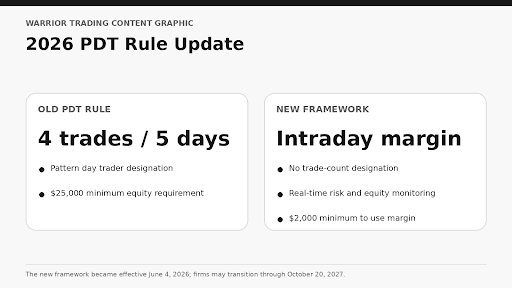
The new framework is based on the equity an account has relative to the positions it holds. It’s a more modern way to look at risk. Based on this update, eligible margin accounts can operate at any level above the standard $2,000 margin minimum. This is great news for small-account traders.
When Does the Rule Update Take Effect?
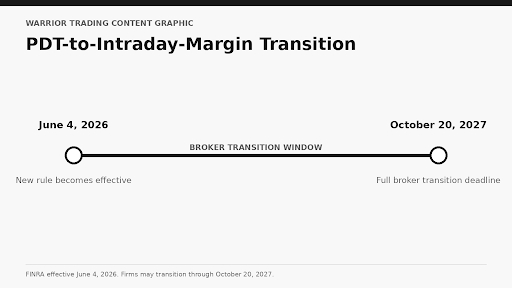
The effective date for the PDT rule update was June 4, 2026, but brokers have until October 20, 2027, to phase in the new requirements. Even after that point, brokers can still set their own specific guidelines for buying power.
How To Day Trade After the PDT Rule Update
Now that the rules of day trading are changing, you have some unique options for how to invest from day to day. While the conversation used to be about loopholes and ways to bypass the PDT rule , the key issue now is how to manage risk and fund your account wisely.
Here’s where I recommend starting out.
Should You Day Trade With $2,000?
The updated rules mean that you can potentially trade with as little as $2,000 in your margin account, which is the standard minimum equity requirement upheld by most brokers. However, I can’t stress enough that just because you may be able to trade with $2,000 doesn’t mean you should.
If you have a $2,000 account, every loss matters. A $100 loss is 5% of the account, for example. The new rule may give you the ability to trade at this scale, but you’ll need to trade small and protect your capital if you choose to do so.
Start With a Simulator
The new PDT rule makes the market more accessible with less capital, but you’ll need practice if you want to avoid getting into trouble.
Using a day trading simulator can help you test different strategies based on the amount that you plan to trade with using your real-world account. These practice rounds prepare you for the risks that come with small-account trading.
Know Your Broker’s Rules
The new FINRA requirements don’t overrule specific rules upheld by your broker, who can limit your buying power based on intraday margin. Before trading with $2,000 or a similar small amount, make sure you know what your broker expects from you.
Consider a Cash Account
In the past, using a cash account was the primary workaround for the PDT rule, which didn’t apply to these accounts. With settled cash, you can make frequent day trades, but there’s a tradeoff. Unlike using a margin account, you may run out of settled funds during the day.
For beginner day traders , this tradeoff can actually be a good thing. It forces you to be selective about your trades and manage risk wisely.
Get Started With Day Trading
2026 may be the best possible year to start day trading. With new requirements that make trading more accessible, it’s now possible to start with as little as $2,000 in some cases. This is a far cry from the $25,000 requirements of the old PDT rule.
Before you get started, make sure you have all the day trading education and practice you need to feel confident. That way, you’ll be prepared for the risks and surprises that every trader faces.
Sources:
Frequent Intraday Trading: Understanding the Basics | FINRA.org
Regulatory Notice 26-10 | FINRA.org
Margin Rules for Day Trading | SEC.gov
Understanding the New Intraday Margin Requirements | FINRA.org