





Why Rules Matter in Day Trading
If you’re just getting started, let me give it to you straight: breaking day trading rules can wipe out your account before you even know what happened. I’ve made those mistakes. I’ve hit those limits. And that’s exactly why I care so much about understanding the rules of the game.
A lot of traders lose money not because they’re bad at reading charts , but because they don’t know what they’re not allowed to do. You can find a perfect setup, take the trade, and then boom, you’re locked out of your account, flagged as a pattern day trader , or halted mid-move.
So today, I want to walk through the core day trading rules that every beginner needs to know — not from a textbook, but from real experience behind the screens.
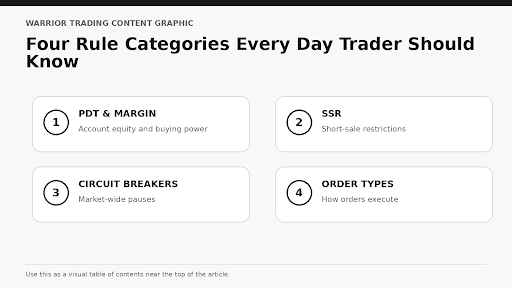
The Pattern Day Trader (PDT) Rule: A Huge Update
For years, one of the biggest barriers to entry in day trading was the Pattern Day Trader (PDT) rule . In the past, traders using a margin account needed to have at least $25,000 in equity for unlimited day trading within a five-business-day period. If you ever fell below the PDT threshold, you could lose your ability to trade.
This rule has frustrated many beginner traders, and it’s understandable. If this rule affected you, you might have felt like you had to trade less often or limit portion sizes. Thankfully, the rule changed in 2026.
Like I discussed in my full post on the 2026 PDT Rule Change , the Securities and Exchange Commission (SEC) announced that, as of June 4, 2026, the minimum for a margin account will drop from $25,000 to $2,000. This massively lowers the barrier to entry for day trading as a whole and may seriously boost interest in the skill.
Why This Matters So Much for New Traders
You can probably already see where I’m going with this: day trading will become more accessible than ever in 2026. However, I can’t stress enough that these lower capital requirements won’t make day trading easier or lower-risk.
The market doesn’t care whether you have $2,000 or $200,000 in your account. Without strong risk management skills , either one can get wiped out surprisingly fast.
The Cash Account Workaround: Still Relevant in 2026?
In the past, traders used cash accounts to work around the Pattern Day Trader rule and its strict $25,000 threshold.
Under the old FINRA framework , lots of new traders chose cash accounts because they weren’t subject to the same PDT margin rules. However, this workaround matters less in 2026 with the dramatic reduction in PDT limits. This means that the cash account workaround might not be relevant to your trading strategy.
Keep in mind, though, that brokers have up to 18 months to implement the new limit. If the updated rules are implemented by your broker, you’ll be able to use a smaller, more flexible account while still meeting PDT standards.
When Does a Cash Account Make Sense?
I would argue that there are still plenty of good reasons to use a cash account in 2026. If you want to avoid leverage and trade only with fully settled funds, it’s a solid option. This applies especially if you are a new trader who wants to simplify your risk.
Margin Account Requirements in 2026
Once you start trading with margin, especially if you plan to short stocks, you’ll have to learn some new rules.
A margin account can give you much more flexibility than a cash account. It also may give you faster access to trading funds, and add extra leverage, letting you take larger positions than you could with your cash balance alone. This comes with an added layer of risk as well.
What Is Margin?
In trading, margin can mean two related things. The first is faster access to capital. In a cash account, cash from a sale becomes fully settled one business day after the sale. In a margin account, you may be able to trade again before the settlement process is complete.
There’s also leverage, which is slightly different. Leverage lets you trade with more buying power than the cash value in your account. For example, if you have $2,000 and your broker gives you 2x buying power, you may be able to take positions up to $4,000.
Why Margin Rules Matter in 2026
With the new framework for day trading accounts in 2026 , margin accounts may become more accessible to smaller traders. However, easier access comes with higher risk.
If you choose to use one of these accounts, you’ll need a clear understanding of your broker’s margin requirements, maintenance rules, margin call procedures, and any interest charges before you start using buying power beyond what’s in your cash account.
Don’t let the elimination of the PDT rule trick you into thinking that you’re immune to margin calls. If your account falls below the required levels, your broker may hit you with one, reducing your buying power, restricting your trading activity, or liquidating positions to bring your account back in line with the requirements.
Trust me: that’s not something you want to see happen in the middle of a fast-moving trade.
Advice for New Traders
If you’re new to day trading, my advice is simple: don’t use margin aggressively until you’re confident that you understand how it works. A day trading simulator can be a huge help in this regard.
However, in addition to the mechanics of a margin account, you’ll also need to be familiar with your broker’s specific rules, especially since there is a chance that not all brokers will adopt the new PDT threshold at the same time after June 2026.
Short Sale Restrictions (SSR)
SSR is active after a 10% drop—only uptick shorts allowed, as seen here on BTAI.
Now this one confuses a lot of traders, even experienced ones.
When SSR Kicks In
SSR triggers if a stock drops over 10% in a day. Once triggered, it stays active for the rest of that day and the next.
What It Means
You can’t short into the bid — only on an uptick. That can delay entries or block your order.
Heads-Up
I’ve missed great trades because of SSR. Always check if it’s active before shorting.
Hard-To-Borrow and Fees
Here’s another hurdle for short sellers: finding shares too short.
Locating Shares
A good short setup doesn’t mean the stock is available to short. Some stocks are hard to borrow.
The Cost of Borrowing
And if they are available, you might face borrowing fees, sometimes over 100% annualized. Sometimes, I’m better off skipping the short and looking for a long setup instead. The fees and logistics just aren’t worth the squeeze. If a stock is on the threshold list, you can’t short it at all.
Circuit Breaker Halts (LULD)
There’s something called the Limit Up/Limit Down rule (LULD), which causes a circuit breaker halt if a stock moves more than a certain percentage in a short time — typically 5% or 10% in under five minutes.
And here’s the truth: I love trading halts.
A lot of people think they’re scary or unfair, especially after what happened with GameStop. But halts can give us the cleanest momentum setups of the day. However, they do come with risks that traders need to understand and manage.
Remember: these only apply during regular hours (9:30 a.m. – 4:00 p.m.). Pre-market or after-hours? A stock can run 1,000% without a single halt.
After-Hours & Pre-Market Rules
Extended hours bring extra risk.
No Halts
There are no circuit breakers , which can mean more volatility.
Low Liquidity
Spreads get wider, fills get worse. Protections are different. So be cautious. A stock can go wild pre-market, and you won’t be able to chase it safely unless you’ve been there before.
Order Types: Stick With Limits
I avoid market orders. I always use limit orders to control entries and avoid slippage , especially in fast-moving small caps.
Tier 1 vs. Tier 2 Stocks
Tier 1 stocks (like Apple) trade differently than Tier 2 small caps. Most halts and volatility issues I deal with Tier 2. Learn the difference.
Understanding Halt Codes
Not all halts are bad. I watch for T1 (news pending) or T12 (halt until disclosure). These codes give clues.
Broker Differences Matter
Each broker handles things differently, from PDT enforcement to borrowing shares. What works on one platform might not work on another.
My Personal Rules for Survival
Beyond the official stuff, I follow these rules religiously:
-
No trading after two red trades
-
No revenge trading midday
-
No oversized positions without A+ setups
-
Max daily loss limit in place
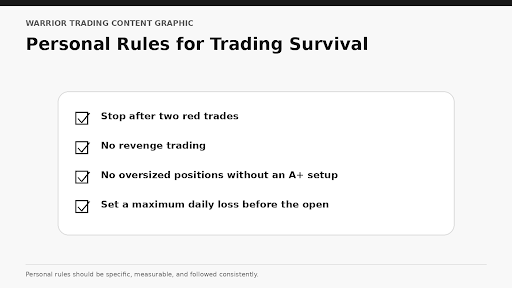
These have saved me from blowing up more times than I can count. Create your own list and stick to it.
Learn the Rules — Then Master the Game
If you want to trade for real, take the rules seriously. I don’t just mean SEC guidelines — I mean the rules that keep you disciplined.
Day trading rewards precision and punishes recklessness. So learn the day trading rules , respect them, and build your plan around them.
Because if you do, this market might just start working in your favor.
Sources:
FINRA Adopts New Intraday Margin Standards to Replace the Day Trading Margin Requirements | FINRA