





Making excellent returns as a day trader typically requires a decent amount of capital to start out, but today, we will cover how to start day trading with $500.
So, allow me to preface this article with that disclaimer: it’s quite challenging to multiply any amount of money in financial markets. Day trading is extremely risky, and most beginner traders lose money. My results should NOT be considered typical. Since you have a high likelihood of losing money day trading, do yourself a favor and trade in a simulator before you put real money on the line. Do not trade with real money until you’ve proven profitability in the sim.
While growing a small account with a balance like $500 or $1,000 can be more comfortable because there are more opportunities available to you, markets are generally efficient, and finding edges is difficult and takes a lot of work and study.
With that out of the way, let’s go over some tips for those beginning to day trade with a $500 account.
The Pattern Day Trader (PDT) Rule Change and Why It Matters
For years, choosing a broker for a small day trading account was all about finding a way to bypass the Pattern Day Trader (PDT) rule. This rule restricted your ability to make more than three trades during a rolling five-business-day period unless you had at least $25,000 in your margin account.
Now, in 2026, the old Pattern Day Trader rule is being replaced with an intraday margin framework. Under this new rule, brokers will focus more on whether your account has enough equity to support the positions you hold throughout the trading day.
Even so, the 2026 changes to day trading rules still generally require you to have at least $2,000 to open a margin account, even with the PDT rule phasing out. This means that with only $500, your options are still limited.
Should You Open a $2,000 Margin Account To Day Trade?
Based on the new PDT rule , some brokers will let you open a margin account with as little as $2,000. This is a bigger upfront investment than $500, but a big draw of the margin account is that it gives you instant settlement of your trades, unlike a cash account where you have to wait a day for them to settle.
However, I’d strongly caution against using just $2,000 to open a margin account, especially if you’re a new trader. The new rules don’t make day trading lower risk, and taking advantage of 4:1 buying power when you’re not ready could wipe out your account within a matter of hours.
If you’re new to day trading and want to open a margin account, you’ll want to consider funding it with more than just the minimum. This amount will give you more room to hold meaningful positions while also managing risk.
What About a Cash Account?
If you’re starting out with just $500, you can also open a cash account. Many major US brokers will let you open an account with this initial amount, but the key thing to understand is that it will be a cash account, not a margin account.
This can be a point of confusion for new traders in 2026, because the PDT rule change lowers the barrier for margin day trading, but you still need to meet that $2,000 minimum to get access to margin (some brokers are still enforcing a higher ceiling until the intraday margin phase-in period is over).
With a $500 cash account, you won’t have access to margin, and you won’t be able to trade aggressively. However, you can still use this type of account to practice at a lower risk level. If your goal is to learn the ropes, though, I recommend starting out in a paper trading simulator .
Your Intentions
What are your intentions with this $500? Do you want to build this account into a larger account quickly? Or do you want to slowly build this account conservatively (possibly depositing more cash as you save up and experience success in your trading)?
I prefer the latter. It’s usually the traders that are most aggressive and excited to multiply a small account that are most uninformed and typically end up losing a sizable portion of their account (if not the entire account) and quickly become demotivated by trading.
Taking the time to build a foundation through day trading courses can help new traders understand risk and make informed decisions.
Chances are if you only have $500 to trade with, you probably don’t have a ton of successful trading experience, so it makes sense to remain conservative and use your small account as a stepping stone.
It’s imperative not to focus on money at this stage. Make sure you’re making right decisions, that you have a good process, and be patient.
The paradox is that, in trading, when you focus on the money, you usually experience more losses than if you’re process-oriented.
As you build up a sample size of successful trades by playing “small ball” with your account, you can always deposit more cash into your account, but you can’t take back the money you lose in the market.
Low-float Microcap Stocks
If you’re seeking significant cash returns from a cash account, your only real option is the low-float microcap market .
Low-floats are like the wild west. Every day, stocks are multiplying in value, stock promoters are pumping stocks to enable insiders to dump their shares, and nobody has any stake in the real value of these companies.
Low-floats are tricky and risky, but the potential offered is massive if you can trade them skillfully. In the low-float market, news moves markets: press releases, capital raises, and stock promoter email blasts rule the land.
Most of the news is fluff, but the upshot of this is that it’s much easier to know why a stock is moving in the low-float market, even if that move is based on faulty premises.
Low-float microcaps are some of the most volatile securities in financial markets. However, most brokers won’t extend you any leverage to trade these and will often restrict you from short-selling them, unless you have a broker targeted at short-sellers.
Setups To Focus On
There are hundreds of different trade setups out there, based on candlestick patterns, indicator values, order flow, etc. Ultimately, setups fall into two broad categories: trend continuation and counter-trend plays. Other strategies capitalize on the range of markets. Both are too crafty to trade with a small account.
For a newer trader with a small account, I think it makes more sense to stick with trend continuation plays. In my experience, they’re both simpler to trade and understand.
Trend Continuation
Within this category, most setups fall into two more broad categories: trend pullbacks and breakouts. A trend pullback setup waits for a pause within a trend to join the trend, while a breakout waits for the market to breach a significant level. That level could be a periodic high or an area of resistance, and it varies case by case.
Trend Pullbacks
The first step to trading pullbacks is by identifying a trending market. The most straightforward method of identifying a market trend is by looking for a series of higher highs and higher lows.
Here’s a basic graph to visualize this:
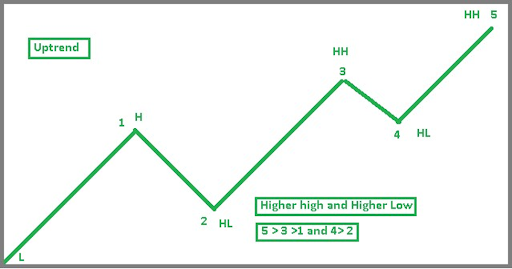
The ideal trend pullback involves you joining the trend on a higher low, and the market continues in your favor with significant momentum.
Beyond simply looking for higher highs and higher lows, we also need a way to quantify the strength of the trend. There’s plenty of uptrending stocks out there that are very slowly increasing by 10% in value over a year, that’s not a very attractive uptrend to look for.
One way of quantifying a trend’s strength is with the use of a momentum oscillator. There are many different oscillators included with each charting package, but they all function similarly: they quantify how quickly the price is moving in one direction.
I like to use two different momentum indicators. The first is called the Average Directional Index (ADX). It’s basically a direction-agnostic oscillator that quantifies how strong a trend is on an index from 0-100.
I use the ADX to strong for stocks in strong uptrends, with ADX values north of 30. The other indicator is a simple MACD. I use the MACD as a tool to gauge how the short-term momentum is looking.
Here’s an example of a stock that I might look for a pullback within:
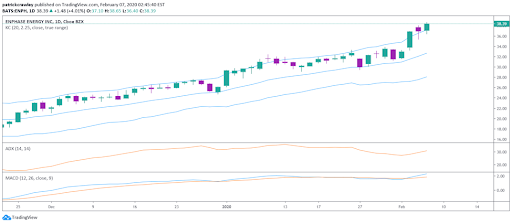
But I can’t enter yet. I have to wait for a pullback. I prefer to wait for the daily chart to close at or below the 20-day exponential moving average, but there are several ways to skin a cat.
If the stock happens to pull back and closes below the 20-day, it needs to have made a new MACD high during its most recent upswing. As you can see, the MACD just made a new high.
If the stock were to pull back now without making a significant new low on the MACD, I might take that trade.
Breakouts
Breakouts are often the first trade setup that new traders are exposed to, and it’s because they’re sexy, and they make sense. Breakouts do offer excellent potential and provide some benefits to learning traders because they present rapid feedback on if the trade worked.
However, the fact is that most breakouts fail.
Here’s some data on the failure rate of breakouts from Thomas Bulkowski’s Encyclopedia of Chart Patterns :
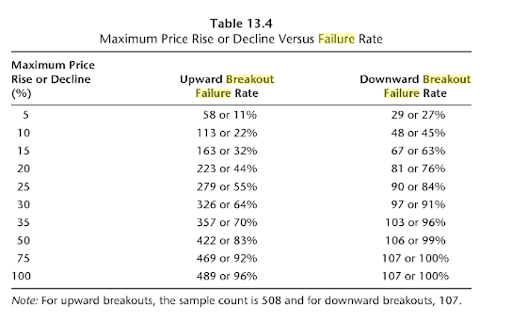
While sacrificing win-rate, the winning breakout trades often do turn out to be huge gainers, so they’re worth paying attention to.
The strongest and most high probability breakouts typically form a strong base (a tight, upwardly trending price range with low volume), experience high relative volume at the breakout point, and don’t return to pre-breakout levels before continuing upward.
Managing Risk
With such a small account, you have no safety blanket by which to support a string of losing trades. For this reason, there is an element of luck at play with growing a small account. Sometimes you can make all of the correct decisions and still make a considerable dent in your account size.
Stop Losses
In order to reduce your risk ruin, it’s vital to cut your losses quickly and set stop losses intelligently. I prefer to use a stop-limit order in this situation, in which your actual stop price is well below the level where you tell your broker to “activate” your stop loss, as to reduce the risk of the stock gapping through your limit order.
It may increase slippage, but it’s better than getting gaped on.
Daily or Weekly Stop Point
Many successful traders make use of daily or weekly stop points. Basically, when they lose a given amount of money in a day or week, they stop trading for the rest of the day or week. They recognize that the cards are not in their favor on that day and don’t continue making losing bets.
Bottom Line
Growing a small account is tough. The industry is created to favor those with a lot of capital, but building a small account isn’t impossible, and many have done it.
It’s also great to view your small account as a starting point. A proof of concept, through which, if you can prove that you can make good trades with, you can continue depositing cash to grow your account size and make things easier on yourself.
Sources:
FINRA Adopts New Intraday Margin Standards to Replace the Day Trading Margin Requirements | FINRA.org
Understanding the New Intraday Margin Requirements | FINRA.org
Frequent Intraday Trading: Understanding the Basics | FINRA.org
Understanding Pattern Day Trader (PDT) Rules and Margin Requirements | Investopedia