





- What Is a Day Trade?
- Day Trade Counting: Key Examples
- Example 1: Simple Round Trip
- Example 2: Multiple Buys, Single Sell
- Example 3: Different Stocks, Same Day
- Example 4: Buy Today, Sell Tomorrow
- Example 5: Options Same Day
- Cash Accounts and Margin Accounts
- Quick Reference: Day Trades Allowed by Account Type
- How Many Day Trades Can You Take in a Cash Account?
- How Many Day Trades Can You Take in a Margin Account?
- What Happened When You Exceeded the Day Trade Limit?
- Frequently Asked Questions
- Do options count as day trades?
- Does buying and selling different stocks count toward the same limit?
- What if I accidentally make a 4th-day trade?
- Do after-hours trades count?
- Do futures or crypto count toward the PDT limit?
- Bottom Line
As with kicking off any career, there are plenty of things you should learn if you have dubbed yourself a brand-new day trader. Not only will you need to decide what to trade, when to trade, and how to manage your risk, but you’ll have to determine how many day trades you can make in your brokerage account.
In this guide, we will go over how many day trades you can make in a week, depending on what type of account you have. We’ll also cover the SEC-approved PDT rule change that will make day trading more accessible to smaller account traders starting this summer.
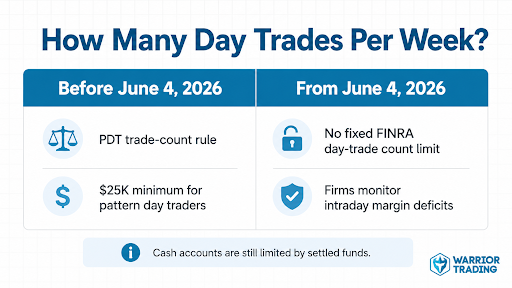
April 2026 Update: The SEC officially approved FINRA’s amendments to the Pattern Day Trader rule in April 2026. The $25,000 minimum balance requirement for day trading in margin accounts has been eliminated. Traders will only need $2,000 to open a margin account and day trade without restrictions, once their broker implements the new rules. Brokers can begin rolling this out 45 days from FINRA’s regulatory notice, meaning as of June 4th 2026, they can implement it, with up to 18 months to fully comply.
What Is a Day Trade?
A day trade is when you buy or short a financial instrument and then sell or cover the same instrument on the same day with the goal of making a profit. Just opening a position without closing it that same day does not count as a day trade.
For example, if you buy 100 shares of XYZ stock at 9:30 a.m. and sell all the shares at 1 p.m. on the same day, you have completed a day trade. If you short sell 150 shares of XYZ at 9:30 a.m. and cover them at 10:30 a.m. the same day, that is also a day trade.
The most common day-traded financial instruments are stocks, futures , and forex. Day traders typically use technical analysis tools and a defined trading strategy to try to profit within a short period of time.
Day Trade Counting: Key Examples
Before we get into how many trades you can make by account type, it’s worth making sure you understand exactly how trades are counted. Getting it wrong can result in an unexpected PDT flag.
Example 1: Simple Round Trip
You buy 100 shares of AAPL at 10:00 a.m. and sell all 100 shares at 11:00 a.m. the same day. This counts as one day trade.
Example 2: Multiple Buys, Single Sell
You buy 100 shares of AAPL at 10:00 a.m., buy another 100 at 10:30 a.m., then sell all 200 at 11:00 a.m. This counts as two day trades. Using FIFO (First In, First Out) accounting, your sell order closes two separate opening positions — each counts as its own day trade.
Example 3: Different Stocks, Same Day
You buy and sell AAPL in the morning, then buy and sell TSLA in the afternoon. This counts as two day trades total. Day trades are counted across all securities in your account, not per individual stock.
Example 4: Buy Today, Sell Tomorrow
You buy 100 shares of AAPL on Monday and sell them on Tuesday. This is NOT a day trade. Both the open and close must occur on the same calendar day.
Example 5: Options Same Day
You buy 1 AAPL call option at 9:45 a.m. and sell it at 1:30 p.m. the same day. This counts as one day trade. Options follow the same counting rules as stocks. For multi-leg spreads opened and closed on the same day, each leg may count as a separate day trade — verify with your broker.
Cash Accounts and Margin Accounts
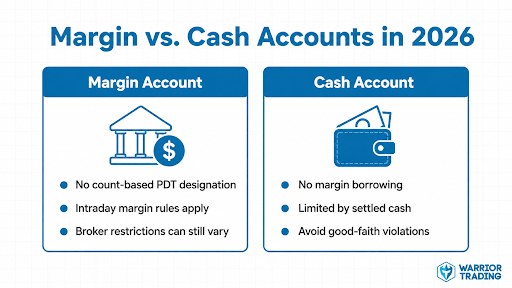
There are two main types of brokerage accounts for day traders: cash accounts and margin accounts . With a cash account, you pay in full for every security you buy and cannot borrow from your broker. With a margin account, you can borrow money from your broker using your securities as collateral, which also unlocks features like short selling and leverage.
Quick Reference: Day Trades Allowed by Account Type
| Account Type | Trades Allowed Per Week | Settlement Wait | Leverage/Buying Power | Short Selling |
| Cash Account | Unlimited (until cash runs out) | T+1 | None | No |
| Margin Account — $2,000 or more | Unlimited (once broker implements new rules) | None | Broker-determined | Yes |
How Many Day Trades Can You Take in a Cash Account?
One of the main benefits of a cash account is that you can place as many day trades as you would like until your cash is used, and you won’t be subject to the Pattern Day Trader rule that applies to margin accounts.
The trade-off is settlement time. As of May 28, 2024, U.S. markets moved to T+1 settlement — funds from a stock sale are available the next business day, one day faster than the previous T+2 standard. So if you buy and sell $2,000 worth of stock on Monday, those funds are available again on Tuesday morning.
The PDT rule was implemented in 2001 by FINRA as a safety measure to minimize the risks of day trading on margin. In April 2026, the SEC approved FINRA’s amendments eliminating the $25,000 PDT minimum for margin accounts. Cash accounts remain unaffected by this change — the PDT rule has never applied to cash accounts regardless of balance. Cash accounts remain unaffected by this rule regardless of what the threshold is.
How Many Day Trades Can You Take in a Margin Account?
On a margin account, you are subject to the PDT rule if you make more than three intraday round-trip trades in any rolling five-business-day period. Under the old rule, you needed to maintain at least $25,000 to trade freely. As of the SEC’s April 2026 approval, that restriction is gone — traders with $2,000 or more in a margin account will be able to day trade without limits once their broker implements the new rules.
If you maintain the required minimum, you have unlimited day trades and 4x buying power . Under the new rules, buying power is no longer a fixed 4x multiple. Instead, brokers will determine your leverage in real time based on risk under the new Intraday Margin Standards system. Some brokers may offer 4x, others 2x or 1x — it will vary by broker. Day trading buying power still cannot be held overnight.
If you are below the threshold, you are limited to three day trades per rolling five-business-day period. Once your broker implements the new rules, traders with $2,000 or more in a margin account will be able to day trade freely with no round-trip trade restrictions.
What Happened When You Exceeded the Day Trade Limit?
If you accidentally made a fourth day trade in a five-business-day period on an underfunded margin account, here’s what happened:
Note: Once your broker implements the SEC-approved rule changes, margin accounts with $2,000 or more will no longer be subject to PDT restrictions. Here is how PDT violations worked historically:
-
Step 1 — Warning (sometimes): Some brokers display a warning before the trade executes. Not all do — never rely on this.
-
Step 2 — Flag: Your account is automatically flagged as a pattern day trader. Your broker will notify you.
-
Step 3 — Restriction: You can still close existing positions, but cannot open new intraday round-trip trades until the restriction is lifted.
-
Step 4 — 90-Day Freeze or Deposit: You must either deposit enough to bring your account to $2,000 or wait out the 90-day restriction. The old $25,000 deposit requirement no longer applies following the SEC’s April 2026 rule change.
Note that under the 2021 FINRA enforcement update, each account is only allowed one PDT violation for the life of the account. A second violation can result in a permanent flag, requiring you to either maintain the minimum balance or open a new brokerage account.
Tips to avoid an accidental flag: Track your trade count manually each day. Remember the rolling five-business-day window, not a calendar week. If you’re approaching your limit, consider holding a position overnight rather than closing it intraday.
Frequently Asked Questions
Do options count as day trades?
Yes. Buying and selling an options contract on the same day counts as one day trade. Multi-leg spreads opened and closed the same day may count as multiple day trades — one per leg. Verify with your broker.
Does buying and selling different stocks count toward the same limit?
Yes. Day trades are counted across all securities in your account. Trading AAPL in the morning and TSLA in the afternoon counts as two day trades toward your rolling five-day total.
What if I accidentally make a 4th-day trade?
Your account will be flagged and restricted. Some brokers offer a one-time courtesy removal — contact your broker’s support team immediately and ask. Otherwise, you’ll need to deposit the required minimum or wait out the 90-day restriction. Once your broker implements the new rules, this scenario will no longer apply to margin accounts with $2,000 or more — the four-trade limit is being eliminated entirely for those accounts.
Do after-hours trades count?
Yes. If you open and close the same position on the same calendar day — even across pre-market or after-hours sessions — it counts as a day trade. Same calendar day is the rule, not the same market session.
Do futures or crypto count toward the PDT limit?
No. Futures are regulated by the CFTC, not FINRA, and are not subject to the PDT rule. Cryptocurrency is not classified as a security under current U.S. law, so the PDT rule doesn’t apply to crypto either. Both can be day traded freely regardless of account size.
Bottom Line
The SEC approved FINRA’s PDT rule changes in April 2026, eliminating the $25,000 minimum for day trading in margin accounts. Traders with $2,000 or more will be able to day trade freely on margin once their broker rolls out the new rules — most competitive brokers are expected to do so close to June 4th, 2026, which is the end of the 45-day notice period of FINRA’s regulatory notice.
Until then, your best option with a smaller account is a cash account . With T+1 settlement now in effect, you can recycle your funds one day faster than before, making cash account trading more nimble than it used to be. You can also change your account type at any time by reaching out to your broker.
Whatever account type you use, the fundamentals are the same: know how trades are counted, track your tally carefully, and never rely on your broker’s interface to catch an accidental violation.
The PDT rule has changed — but during the transition period, your broker may not have implemented the new system yet. Check with your broker directly to confirm when the new rules will take effect for your account.