




Watch Full Video Here: I Reset My Account to $2,000 (AGAIN) Webull Challenge Ep 1
When opening a trading account, you have the choice between a margin or cash account.
Cash accounts have long been an option for avoiding the Pattern Day Trader Rule restrictions that came with margin accounts. With the PDT Rule restrictions coming to an end on June 4th, 2026, cash accounts may not be as popular among traders but they are still an option.
Margin accounts require a starting balance of $2,000. So, for someone wanting to start with a very small account, a cash account may be the way to go. The minimum balance to open a cash account will vary from broker to broker.
When I trade in a cash account, everything feels different. The limitations, the psychology , and the timing all force me to slow down and make every decision count. And if you’re starting with a small balance, understanding how a cash account really works can be the difference between steady progress and constant frustration.
Let me break down what actually happens behind the scenes when you try to day trade with settled cash and the approach I use to make it work.
What a Cash Account Really Is
A cash account is simple: I can only trade with the money that has fully settled in my account. There’s no leverage and no instant replenishing of buying power.
That sounds great until you realize how fast that money disappears once you start taking trades.
If I take one trade with my entire balance, that’s it for the day. Once I close that trade, I can’t take any more trades until tomorrow. I’ve got to wait for it to settle overnight.
Can You Day Trade With a Cash Account?
Yes, you can. And plenty of new traders do exactly that. But you have to understand the constraints:
-
Your buying power resets only after the trade settles
-
You can technically take unlimited day trades
-
But you’ll quickly run out of cash if you use your whole balance
-
That often means one or two trades per day max, depending on your account size
This is why I say it’s both possible and restrictive. It’s freedom with handcuffs. A margin account gives you flexibility with instant settlement of trades. A cash account makes you slow down.
The One-Trade-Per-Day Reality
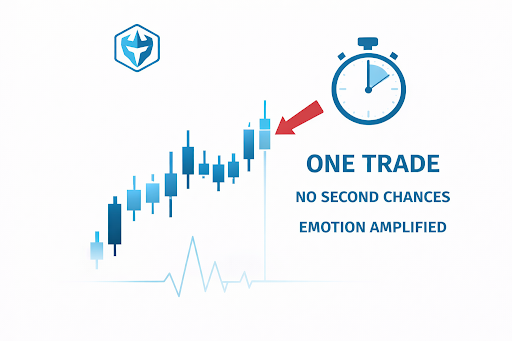
Most traders underestimate how intense this feels. When I only get one shot, every decision matters. The pressure builds. The hesitation creeps in. Traders freeze on the A+ setup because they think, “If I’m wrong, my day is over.” Then the move happens without them.
And what comes next? FOMO. FOMO and emotions can be overpowering because you know that one trade has to count. This is why so many cash account traders struggle. It’s not the mechanics, it’s the psychology.
Why Cash Accounts Can Feel Riskier
A cash account can be less risky because there’s no leverage. But emotionally, it can be harder.
Here’s why:
-
You often can’t scale in or out
-
You typically can’t take multiple small trades to warm up
-
You often can’t “get back in” if you miss your first opportunity
-
You tend to force trades because you don’t want the day to feel wasted
It becomes a game of waiting and then making the perfect shot. That’s not easy, especially for new traders who haven’t built enough discipline or pattern recognition yet.
The FINRA Rule Change: A Big Shift Coming
FINRA recently approved an change, ending the Pattern Day Trader rule . Now, margin accounts can be opened at the minimum of $2,000 and no longer have trading restrictions if they are under $25,000. The changes take effect June 4th, 2026.
Whatever I do during this small account challenge with $2,000, I’ll be able to do it at a much faster rate once this rule change goes into effect.
When brokers fully implement this update, it will reshape the small-account world. Traders will have more flexibility, more opportunities to take trades, and fewer restrictions holding them back.
Until then, a cash account is still the most accessible option for traders operating below the current PDT threshold.
How I Trade in a Cash Account
If I’m limited to one trade a day, that trade has to be exceptional. I’m not interested in “maybe.” I’m waiting for the setup that checks every box.
Here’s what I look for:
Price Range
I stick to stocks between $2 and $20. Cheap enough for share size, volatile enough for opportunity.
Relative Volume
Five times average volume or more. If the crowd isn’t there, neither am I.
Breaking News
Momentum doesn’t happen in silence. Almost all my biggest winners come from catalysts.
Float
I focus on stocks with a float under 20 million shares, and when the market is colder, I tighten that down to under 5 million. Lower supply makes it easier for even a moderate amount of demand to create a strong move. That’s the kind of environment I want when I’m trying to grow a small account.
The One Pattern I Trust Most: The First Pullback
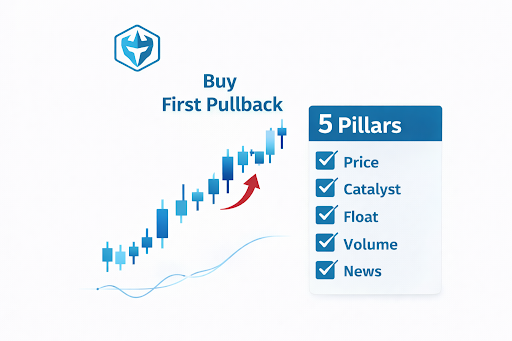
When I’m working with a small account and limited buying power, I want the highest-probability setup in my arsenal: the first pullback after a strong surge.
Here’s how it works:
-
Stock breaks out with strong volume
-
It hits my scanner with fresh momentum
-
I pull up the chart immediately
-
I check the five pillars: price, catalyst, float, volume, news
-
I wait for the first orderly pullback
-
I buy the first candle to make a new high
But this only works when the MACD supports the move. If the MACD flips from positive to negative, I’m not touching it. That rule keeps me out of countless false breakouts.
Why Discipline Matters More Than Tools
Cash accounts punish emotional trading harder than anything else. If I break my rules in a margin account, I can sometimes dig myself out as an advanced trader. In a cash account? I’m done for the day.
To stay sharp, I constantly review my data. I pay close attention to my accuracy, my average winners versus losers, the price ranges where I perform best, the floats that consistently work for me, and even the times of day when I’m trading at my highest level.
Analyzing performance is critical: You need to understand what you’re doing well and what needs improvement. Without that feedback loop, small-account traders get stuck fast.
Final Thoughts
You need to understand the rules of the game to trade with the cash account. A cash account forces patience, discipline, and precision. You only get one or two real chances each day, and those chances have to count.
For traders learning the fundamentals , a cash account can be a great training ground by keeping the focus on quality trades. For traders battling emotions, it can expose bad habits quickly. And with the upcoming FINRA rule change, the path to more flexibility is right around the corner.
Trade smart, focus on A+ setups, and keep your emotions in check. One great trade a day is all it takes, if it’s the right one.