




The First Time I Got Halted
I was watching a stock climb fast. Then, nothing. The chart froze. Orders wouldn’t fill. I thought my broker was broken.
It wasn’t. The stock had been halted.
If you’ve been day trading for any length of time, you’ve probably run into this. And if you’re new, you will. Trading halts are a normal part of the market, especially in the small-cap, high-momentum stocks I trade every day. Knowing why they happen is the difference between panicking and making a smart decision.
Let’s break it down.
What Is a Trading Halt?
A trading halt is a temporary suspension of trading in a stock. No orders get filled. The price freezes. It can last anywhere from five minutes to several days, depending on the reason it was triggered.
Halts are enforced by exchanges (Nasdaq and NYSE) and sometimes by the SEC. They’re not random. Every halt has a reason, and that reason is communicated through a specific halt code . Knowing those codes tells you a lot about what’s coming next.
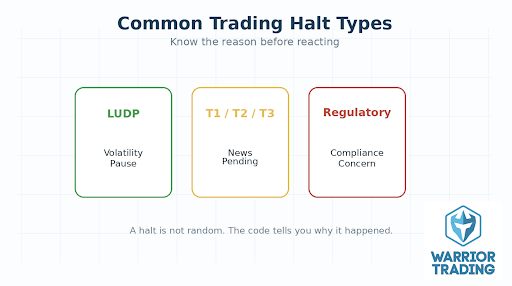
The Most Common Halt: Volatility Pause (LUDP)
The halt I run into most often is the circuit breaker halt , also called a volatility trading pause. The code is LUDP (Limit Up/Down Protocol).
Here’s how it works: Every stock has a volatility band (an upper price limit and a lower price limit). These bands are calculated based on the average price over the last five minutes and update every 30 seconds. If the stock’s bid stays pinned at the upper band for 15 consecutive seconds, the exchange halts it. Same thing on the downside — if the ask stays at the lower band for 15 seconds, it halts down.
The halt lasts a minimum of five minutes. If there’s still a big order imbalance when time’s up, it extends in five-minute intervals, so you’ll often see halts run 5, 10, 15, or 20 minutes.
When a stock halts going up, that’s not necessarily bad news. It means the stock is moving so fast the exchange hit the brakes. If you’re already in the position, you may open to a higher price.
The volatility thresholds vary by stock price. For most small-cap stocks above $3, the threshold is a 10% move within five minutes. Stocks between $0.75 and $3 have a 20% threshold. These bands also double in the last 25 minutes of the trading day to account for the natural volatility near the close.
One thing that trips up new traders: a stock can go up 200%, 300%, even 500% without ever halting, as long as the move is gradual enough that it never exceeds the band for 15 seconds. The halt isn’t about total percentage gain. It’s about speed.
News-Pending Halts (T1, T2, T3)
The second type I see regularly is the news-pending halt. This one follows a sequence.
A T1 halt means the company has requested that trading be paused while they release material news. That could be an earnings announcement, an FDA approval, a merger, a secondary offering — anything that could significantly move the stock. The idea is to give everyone equal access to the information before trading resumes.
Once the news is released, the code changes to T2. The stock is still halted, but the news is out. Then it moves to T3, which signals that trading is about to resume.
These halts can last a few minutes or several hours. If a T1 is dragging on longer than you’d expect, that’s usually a sign the news isn’t good. Companies don’t tend to delay releasing positive catalysts.
If you’re holding a stock through a T1 halt, you need to be honest with yourself about the risk. You can’t exit. You’re along for the ride until it reopens.
Biotech stocks are notorious for this. A company waiting on an FDA decision can halt right before the announcement. When it reopens, it might be up 100% or down 80%. That’s the reality of holding through a news halt, and it’s why position sizing matters so much.
Regulatory Halts
The third type is the regulatory halt (codes like H10 or T12). These are the most serious. They’re triggered by concerns about fraud, insider trading, accounting irregularities, or other compliance issues. The SEC can suspend trading in a stock for up to 10 trading days.
Luckin Coffee is a well-known example. In 2020, the stock was halted after a massive internal fraud was uncovered and eventually delisted. If you see a regulatory halt, assume the news is bad. These aren’t situations where you want to be holding and hoping.
Market-Wide Circuit Breakers
There’s also a fourth type: market-wide circuit breakers. These are rare. If the S&P 500 drops 7% in a single day, all trading halts for 15 minutes. A 13% drop triggers another 15-minute pause. A 20% drop shuts down trading for the rest of the day.
These rules came out of the crash of 1987, when the market dropped 22.6% in a single session. We saw them triggered multiple times in a single week in March 2020 during the COVID selloff.
How To Handle a Halt When You’re in a Position
When a stock I’m in gets halted, I use the pause. I check the news feed. I look at the Level 2 to see where the LULD prices are. I think through my exit plan for when it reopens.
The biggest mistake new traders make is firing off a bunch of orders during the halt without thinking through the risk. If the stock opens significantly higher or lower, those orders can fill at prices you weren’t expecting. That’s exactly why day trading risk management has to be part of your process before you ever enter a trade.
Stay calm. Use the time. Don’t let the silence make you panic.
You can monitor live halts on the Nasdaq Trader halt list at nasdaqtrader.com . It updates in real time and shows the halt code, the stock, and the expected resumption time.
What Halts Really Mean for Your Trading
Trading halts are not your enemy. They’re part of the game. The market pauses for a reason, and understanding that reason gives you an edge over traders who just see a frozen chart and freeze up themselves.
Circuit breaker halts on fast-moving low-float stocks is something I deal with multiple times a week. They can be exciting, especially when the stock opens higher after the halt.
News-pending halts require more caution, because you’re holding through uncertainty. And regulatory halts are a reminder to always manage your position size, because sometimes a stock doesn’t come back.
The more screen time you put in, the more comfortable you’ll get with these situations. Comfort in the market comes from understanding, not from hoping things work out .
Want to go deeper on circuit breaker halts, volatility bands, and how to trade the resumption? Check out my full breakdown in Warrior Trading’s Circuit Breaker Halts guide .